
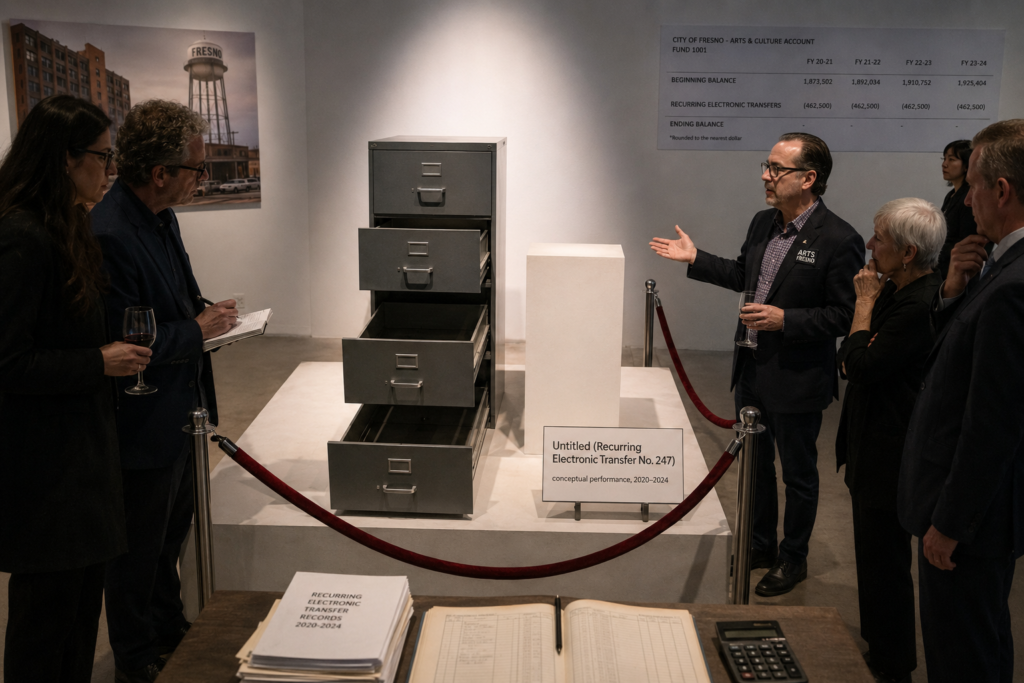
FRESNO, CA — Following the sentencing of former operations manager Suliana Caldwell for embezzling approximately $1.8 million, Fresno-area arts officials expressed relief this week after determining that the disappearance of an enormous quantity of money could simply be reclassified as an ambitious four-year experimental performance exploring absence, institutional trust, and PayPal.
Caldwell was sentenced to 33 months in federal prison after admitting to transferring Arts Council funds to herself hundreds of times over several years and falsifying financial records to conceal the transactions.
Local arts observers said the work represented a radical departure from traditional Fresno artistic practice, particularly because previous publicly funded installations had generally remained physically present after completion.
“Most artists merely depict greed, corruption, or institutional neglect,” said contemporary-art critic Pamela Dresch, standing thoughtfully beside an empty filing cabinet. “Caldwell challenged us to ask a much more difficult question: What if the grant money itself became the medium?”
The sprawling conceptual piece, provisionally titled Untitled (Recurring Electronic Transfer No. 247), reportedly consisted of approximately 300 individual transactions, each representing what curators described as a “small but emotionally devastating meditation on internal accounting controls.”
Arts officials praised the work’s unusually immersive quality.
“You couldn’t just look at this piece,” said one curator. “You had to experience it gradually over four years while having absolutely no idea it was happening.”
According to federal prosecutors, Caldwell repeatedly transferred money from Arts Council accounts into accounts she controlled and altered records to conceal the activity.
Critics said the falsified documents formed an essential secondary component of the installation, functioning as a kind of bureaucratic trompe-l’oeil in which spreadsheets appeared to contain money despite, upon closer inspection, containing significantly less money.
The work culminated only after investigators discovered that approximately $1.8 million had vanished, prompting what several local arts advocates described as “the audience-participation phase.”
“That’s really when the piece became interactive,” Dresch said. “Federal agents entered the gallery, subpoenas were issued, accountants became emotionally involved. Suddenly everyone was part of the performance.”
Approximately $563,000 has reportedly been recovered through PayPal, though Fresno officials have indicated that recovered funds have not yet made their way back to the city.
Art historians said the partial recovery should not be viewed as diminishing the work.
“Quite the opposite,” said Dresch. “The return of some of the money introduces themes of impermanence, restitution, and the cruel human desire to see $1.8 million eventually reconciled on a ledger.”
Federal prosecutors declined to acknowledge the installation’s artistic significance, instead repeatedly referring to the project using the more conventional criminal-justice term “embezzlement.”
That terminology drew criticism from members of Fresno’s experimental-art community, who warned that criminalizing the unauthorized removal of nearly $2 million could have a chilling effect on future avant-garde financial practices.
Arts Council officials have since announced a comprehensive review of internal procedures and said safeguards are being implemented to ensure that no future employee can accidentally create a multimillion-dollar conceptual artwork without prior approval.
Among the proposed reforms is a new two-person authorization system requiring a second employee to independently verify any unusually large transaction before funds can leave an account.
Officials described the policy as groundbreaking.
“Previously, our accounting philosophy was built around trust,” said one fictional administrator. “Going forward, we’re introducing a promising new concept called ‘checking.’”
The organization is also reportedly considering quarterly bank-statement reviews, mandatory financial audits, and a computerized alert triggered whenever an employee attempts to transfer enough public arts funding to purchase a moderately priced home in Fresno.
At press time, city officials were standing silently before the Arts Council’s remaining account balance, debating whether it represented a budget shortfall or an extremely minimalist sculpture.